Showing posts with label social. Show all posts

Saturday, June 30, 2012

Growing the Weavr feature-set: A story of algorithms and data visualization

After a comment by David Bausola, stating that any discussion of weavrs should include a conversation about the bot's feature-set, I went about looking for a way to optimize this creature given what I had previously discussed (i.e., emphasizing its machinic qualities). My initial direction was driven by two impulses. One, when I had first attempted to create a weavr, I had tried to 'upload' every possible conceptual connection into its little box of "What Words Define Who I Am?" Sadly, this approach failed miserably as there seemed to be some cap on the number of words I could input. Two, the weavr, in my mind, was a social tool that helps us simultaneously better understand our social mechanisms while decentrating those mechanisms away from their proto-human bias (e.g., intention, individuality, will, etc.). The goal not being to make 'Man' more like 'Machine,' but to obliterate the distinction altogether: sapiens machina.

Shortly after plunging into this exploration, I stumbled upon the work of Kevin Slavin, once again through CBC's Spark (179). It was a beautiful marriage. Slavin's discussion of 'algorithms as nature' only reemphasized my second motivating impulse: if something as stereotypically 'artificial' as an algorithm is in fact natural or a part of Nature--yes, the reified capital 'N,' Nature--then perhaps humanity had best reconceptualize the machine-human-nature relationship. That is, humanity's view of both 'Nature' and 'Machine' as diametrically opposed 'Others' is a serious hindrance to its self-conceptualization. It isolates the system from both its past (Nature) and future (Machine or hybrid) by making itself the indivisible divider: the Individual. Thus, for the very idea of 'algorithms as nature' to even make sense, one must decentralize their current conception qua relation to the 'world.'

In his Ted talk,  Slavin pushes this idea even further. Not only are  algorithms beginning to dominate on the internet, in economics, and even in culture, but they are producing in these domains in a way that is incomprehensible to humanity's current perceptions. When changes are thus occurring in the system, we cannot see them, predict them, or understand them. To use my own jargon: as the machinic level of organization gains ever increasing precedence, our need for an integrative approach, a language and framework, in which to operate in this domain is of the utmost importance.

With this problem in hand, I reapproached the discussion of the weavr's feature-set. If the weavr is a tool that can help our growing understanding of the machine-human-nature triad in the context of social mechanisms, it must in some way answer a particular question related to this problem. It must bring an implicit element of this relationship into an explicit manifestation. It must help us 'see.' However, I do not believe the weavr is so simplistic that it can only help us answer one question. Rather, it seems to have the flexibility to answer many depending on the context we impart to it. Thus, this context and its particular implementation is a key point. For the Encodingist, it is the point at which we breath 'life' into the organism. For the Interactivist, it is the framework in which an 'answer' will emerge and grow. And, in its current manifestation, it is more art (implicit) than science (explicit).

To anticipate a future critique: I have no problem with art and some might argue that art has explicit manifestations. It does. My point is just that the ambiguity of a gestalt does not offer the necessary formality needed to develop a framework for the language of the sapiens machina.

Perhaps, on the other hand, the distinction between science and art is a tad crude. Instead, it may be more accurate to say that the weavr needs more structure to better ground its implicit qualities. The goal, after all, when working at this level of abstraction and cross-domain integration (i.e., machine-human-nature) is to utilize the methods of both: to crystallize just enough of the raw potentialities that the underlying emergent qualities remain visible (i.e., do not stagnate in crystallization) but neither do they vanish in the vivid halo of a hallucination. The weavr is unique because it already sits at this intersection. This brings me to my second key point: the 'answer.'

Currently, we can gather a primitive answer by asking the growing weavr various questions, seeing what new emotions and their respective associations it has picked up, examining what it has stumbled upon on the web through its posts, etc. However, most of this is very distant from the original question as it was framed in the context we uploaded into the weavr's system. Words may repeat or appear. Certain vague patterns suggest themselves, but the creature is rather opaque. I lack a way to 'see' into the world of the weavr as it has changed through its interaction with its environment and self. Without giving it a series of questionnaires before and after certain time frames as I might a human, I am left in the dark. Thus, perhaps the construction of the weavr is overemphasizing the 'human' qualities of the system in order to demonstrate their ontology With this emphasis, it is easy to forget the beauty of the underlying formality of any digital structure. The architecture of the code and the digitized information offers the perfect entry point for further formalization qua  crystallization of emergent features. In less rigorously formalized systems like humans, this is much harder to accomplish. Thus, we must not forget the 'machine' part of the machine-human-nature interrelation.


On the other hand, it is possible to argue that the questions the weavr answers are not a part of the local system per se, but emerge through the way in which humanity interacts and responds to it a la Jon Ronson. I agree with this, perhaps, as a third point. However, even if this is the case, then there still needs to be a method in which we can examine these features. Perhaps a prosthetic that maps global patterns of behavior across different feature sets (e.g., other prosthetics). Perhaps one that allows a weavr to look through various search engines for reference to itself and comment on it. The more information that is mapped, the greater the number of relations, the better as far as I am concerned.

I choose to shirk the discussion of evaluation or quality because of the necessary context that must be presupposed. If we take information generically in whatever limited way we can, then sheer volume is beneficial as it allows for a multiplicity of contexts. It places less restriction on the questions that might be asked. In this case, more is better. But, this 'more' still requires a method of interpretation: a way to 'see.'

Data visualization is an area of study that fits perfectly into the framework in question. A Ted talk by David McCandless offers an excellent introduction and illustration of the field. In a nutshell, McCandless demonstrates that graphical metaphors offer an incredible way to condense massive amounts of data into comprehensible packages. It offers a clever method to make implicit phenomena blatantly explicit. It allows our natural processes to integrate our visually dominant, human-centric world with one of probabilities, statistics, and mass-scale data patterns: the machinic level of organization. Thus, data visualization or perhaps data design is the perfect language for the future sapiens machina.

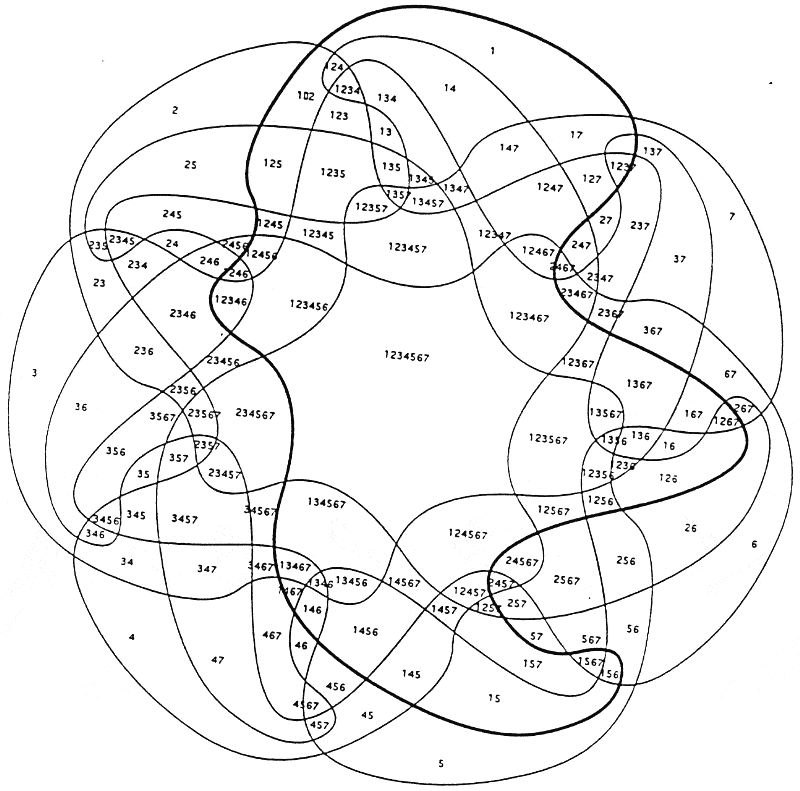
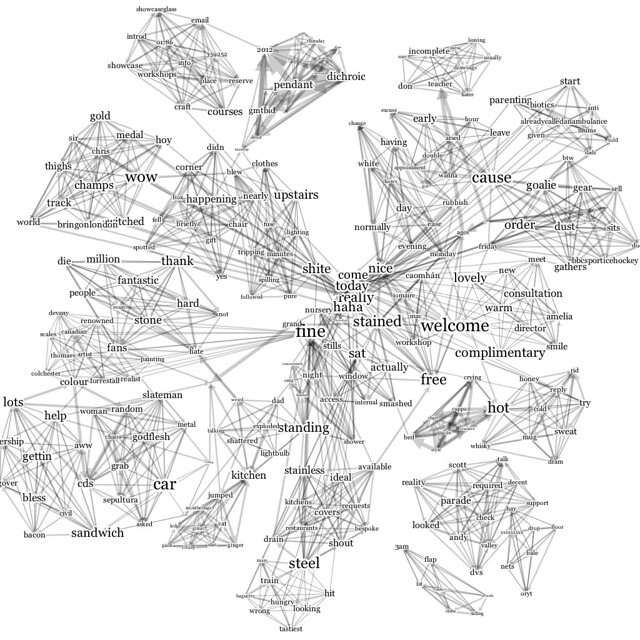
One design framework or technique I commonly use to conceptualize abstract spaces, especially if they are highly interconnected or system-based, is an intersection of graph and set theory. I 'see' nodes and edges or bubbles and lines. Yet, I also see more than that. I 'see' sets of nodes and edges denoted by any type of pattern in the graph (e.g., a node, a cluster of nodes, a clusters of clusters of nodes, an edge, potential edges, external data sets/properties, etc.).

One way in which I could see an implementation of all of the ideas discussed here is through this framework. That is, rather than boxes or categories into which the user drops various words and still further categories that draw the relations between these words, give the user an elementary graph. Let them drop their words into bubbles and connect them via lines to other bubbles. When you want to add sophistication, allow the bubbles to represent clusters of bubbles (i.e., filter or restrict the current domain of inquiry). I like to think of this as collapsing dimensions in phase space. Then, as a second feature, allow the user to check back on this graph in future states and 'see' what new connections have developed or new nodes have appeared. Searching for self-references is but another way to further this map. And, allowing the maps to feed into one another (i.e., accessing another weavr's map through a node) would allow for even larger gradations of abstraction as you move up or down the ladder of organization (i.e., micro or macro patterns). In some way, I can see this as a development of a social semantic web.

In case this idea interests, there are a variety of python graph APIs that might be useful. This site has a link to a bunch of them. Not all have visualization features.


Pictures courtesy of:

Tuesday, June 26, 2012

Machinic: An illustration through Bausola's Weavr

Inspired by a podcast of the CBC radio show Spark, especially given my previous post, I have decided to expand the idea of machinic organization as it relates to David Bausola's weavr: a social bot. 

Nora of Spark starts her discussion with the observation that traffic on the internet is shifting from a predominantly user-based environment to one that is dominated by bots and their ilk. That is correct. Humans are no longer central in the framework of the internet. In some sense, we have been replaced by bots and not with a resulting decrease in quality. In fact, given that these bots aid in the creation of networks that support things like Google's search engine, one could argue that things have improved. A great deal of these bots are also maliciously related (e.g., spam bots) so one could argue in the other direction as well. It is a moot point whether this is for better or worse as it is happening regardless. The point is that not only was the persistence and functioning of the internet not tied to any particular individual, but it was not even tied to any particular system--where 'system' is used very abstractly to represent any organized assemblage of parts including humans and bots. Thus, the shift emphasizes or highlights what some have described as a decentration and one in which both humanity and individualism must be replaced by a framework of broader scope. In this ever changing landscape, the weavr comes to the fore.

The weavr is a strange bot that operates in social networks of various kinds. It defaults to having a blog and can be interfaced with Twitter. It dialogues, wanders around with Google maps, and draws associations between its 'interests,' 'emotions,' and various other associations (e.g., its position on Google maps and the position people are posting various materials from). On the broad side, it even dreams.

I simply adore this little creature and Bausola's emphasis on the idea of emergence is certainly invigorating. However, I recently had a shift that changes my relation to this idea as it relates to AI. The shift occurred with a thought that was similar to the following:

If a 'truly' novel intelligence on par with humanity were to be created, what benefit would come to humanity?


The thought stemmed from the work of Mark Bickhard. I briefly commented on a similar element of Bickhard's work in the latter part of this post. Briefly, Bickhard's critique of representation in the Encodingist framework results in the following dilemma: any construction qua representation that I overlay over this hypothetical 'super' AI must necessarily be separate from the functioning of that AI.

It is worth noting that I am neither being a phenomenologist nor an epiphenomenalist when I make the previous claim. It is an entirely different framework. To emphasize this, I will switch my use of the Encodingist 'representation' to the Interactivist 'anticipation' while relying, somewhat, on the common sense view of anticipation to get me through the analogy. The result follows: my anticipations of the AI are separate from the functioning of the AI much like my anticipations of other people are separate from the functioning of other people. The key point here is that my anticipations can be wrong and hence have to be separate. This "have to" is crude, but a more sophisticated discussion is beyond the scope of this post. I urge anyone who is interested to read Bickard's text for a much more detailed and eloquent rendition of the problem, especially Chapter 7, p. 55 and onward.

Given this framework, the 'super' AI, at the moment of its attaining this level of sophistication, becomes inherently 'Other' to me. But, this degree is just the beginning as even other humans can be 'Other.' There is also the difference of species: my framework of anticipations was built in interaction with other humans. And, though my association between the AI and humanity was originally justified in the construction of the 'AI as tool,' the 'AI as self-organizing/maintaining system' is outside of this domain. Thus, it warrants the description as 'truly alien.'


One could argue that we have at least elementary forms of such self-organizing systems and, as such, the transformation would not warrant the degree of 'Otherness' that I am proposing. However, I would argue that this is false. At most we have more sophisticated forms of 'AI as tool' that allow for modest degrees of self-organization in respect to a specific task. Simultaneously, then, I can push the requirements for this purely hypothetical 'super' AI further out by requiring that they posses the ability to be "recursively self-maintaining" a la Bickhard (p. 21).

Regardless, my point is that this transition of the AI from a tool to a functioning entity is not useful. First, the very idea that there could be a transformation is Encodingist: it is the magical transformation that takes a material substrate, 'AI as tool,' into the efficacious realm of a symbol manipulator, 'AI as individual or recursively self-organizing system.' In Interactivism, there is no such transformation. If anything is problematic, in the Interactivist context, it is systems that are more than locally self-organizing, which are more likely to be unwieldy. Thus, and to my second point,  I can only imagine how problematic it would be if I had to convince my calculator  to crunch numbers for me.

To return to the discussion of weavrs but in this new context, we can work towards a better conceptualization that does not have the Encodingist overtones of Bausola's infomorph while maintaining its machinic qualities. Weavrs are a new type of social tool. They emphasize the growing shift on the internet away from users and towards pseudo-autonomous functions by invading into a domain that previously excluded bots by definition: the social sphere. They also give us insight into some elements of how we as humans work, but not by possessing the individualistic properties of humans (e.g., intention). Rather, it is by showing that humans do not have those properties either.

This is the decentration. This is why it is called "machinic" organization. This is also probably why Jon Ronson got so upset about the weavr of the same name: not only does the weavr partially delegitimate the particular individual, it delegitimates all individuals even if just potentially (i.e., even if some future update may take it to this degree entirely but the current one is still too limited). Thus, I believe I can answer both Olivia Solon of Wired's question, "what do you think of weavrs?" and Bausola's question about what weavrs are in a single comment:

Weavrs are simply a tool for social exploration. But, by being such, they anticipate a time when all such exploration is relegated to their ilk. Through this anticipation they mark the end of humanity as organism... as 'system' par excellence and in place they speak of a time when a human-function is no more valuable than an AI-function and no less replaceable. This is of the utmost significance to both the study of AI and humanity as it relates to itself.


Pictures courtesy of:
http://www.goldrootherbs.com/2010/10/11/the-systemic-theory-of-living-systems-and-relevance-to-cam/
http://twitter.com/#!/PixelNinjWeavr
http://www.myjewishlearning.com/blog/rabbis-without-borders/2012/02/14/the-singularity-vs-the-gift-of-death/
http://www.evolo.us/architecture/architecture-designed-to-simulate-self-organizing-biological-systems/
http://www.flickr.com/photos/philterphactory/6829175342/

Sunday, June 24, 2012

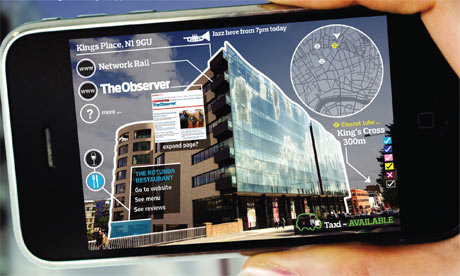
Augmented reality 2.0

It seems that I was previously mistaken. There are a number of groups that are implementing preliminary hardware and software for mobile and otherwise that is beginning to collapse the divide between our cyber and material worlds.

It's hard to comment on all of this stuff as I am a tad overwhelmed. Nevertheless, here are some preliminary thoughts.

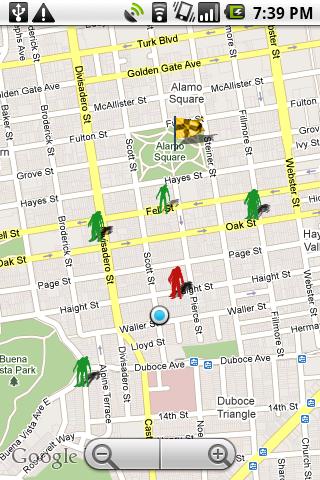
For the games, I would like to see some gaming classics like PacMan get reinterpreted. It would also be nice to see someone explore the current limitations of our hardware so that we have an idea of where the boundary is in this domain. I think the explosion of excitement in this industry, though wonderful, had best be reined in. The domain is potentially infinite, but currently has some solid limitations in our hardware and software design. Rather than see programs and apps that really push the limits, I would like to see some slightly more modest but functional attempts. Take one facet of the infinite potential and develop it until it has some obvious practical usefulness. And, though I love these ideas (1 2), wearing a giant suit or helmet is... not feasible.

In this vein, I think I am following other thinkers. The importance of finding ways in which augmented reality, given its current limitations, can legitimately reinforce or support our current existence in our environments is pertinent. That is, given a camera, gps, a small screen or primitive glasses (1 2), an accelerometer and/or gyroscope, a live feed to the internet and the cloud, audio input/output, and a touch screen, what can be implemented?

The cloud offers the ability to extend our memory capacity if we can find a seamless way to 'recall' the information or begin to implement triggers (e.g., visual, auditory, etc.). If someone could find a way to integrate this with multilingualism (i.e., by having a list of common phrases, etc.), I think traveling would become much simpler.

The accelerometer and gyroscope offer an alternative to touch screens. Just hold your phone and swipe it around like a computer mouse. In fact, I'm surprised I have not seen any software implementing smartphones as UI for standard computers. Though, I have heard of other countries using it for UI more generically. And, actually, the idea of being able to graphically scan anything and have my smartphone find where I can buy it, virtually or otherwise, is certainly worth exploring.


This software has some interesting uses socially. I can see a time when people have clothing that encodes their 'avatar' (i.e., appearance) in cyberspace so that they are seen as such through AR. Subcultures, I'm sure, will be able to integrate this as an interesting form of identification. There are possible consequences here for gangs, etc.  as well as the police. On the extreme end, machines could be seen in a more anthropomorphic frame, which might have interesting repercussions for our relationships with them and we may be able to project our avatars to new places in order to send cues, or even interact with the world. Imagine your phone's 'ring tone' was the person appearing in your peripheral vision and waving at you. Interesting implications for the research I have heard on less invasive forms of human-computer interaction.

Actually, this would be an interesting way to implement some of the ideas I discussed previously. I could have it such that messages or social cues, interests, etc. are encoded right on my person (e.g., approachable, busy, single, etc.). If people start doing this with tattoos, that would certainly be fascinating. And, to forecast a future post, the ability to tag others given a particular network or context would be fascinating, too, especially with ratings.

Images courtesy of:
http://www.guardian.co.uk/technology/2010/mar/21/augmented-reality-iphone-advertising
https://t.co/5jjnouAY
http://strangehorizons.blogspot.ca/2011_06_01_archive.html

Thursday, June 21, 2012

iWitness and tech acceleration part 2

This is a continuation of my last post; the gist being that this new app is a surprisingly close approximation of a project I was working on myself. However, it is missing some features that I would like to describe.

A word of warning: I lack an internal description of the app's functioning. Hence, some of these adjustments may not be applicable or may have already been implemented.

First, it would be useful to have a brief description of each and every client that could be sent to the police in addition to their GPS coordinates.

Second, if raw GPS data is being sent, one can implement a more detailed description of the clients whereabouts leaving less processing on the side of the police. A lot of the difficulties associated with E911 are related to the challenges in locating an individual when they are not calling from a land line. The result is that an operator must reroute you from a central hub in order to place your call to the appropriate PSAP (i.e., valuable time is being wasted and you have to be able to speak). Thus, by sending even raw GPS data, iWitness is minimizing the second factor, but increasing the first if the integration is not seamless (i.e., processing of the raw GPS coordinates must occur without forewarning). My solution to this problem was to use this site to determine the nearest street address as well as the Country of origin (necessary for global implementation), etc. The long-term goal was to be able to route to the PSAPs directly.

Third, it would be my hope that the producers of iWitness will be keeping track of the statistical usage of their app. All of that data related to when and where the app is armed and fired is likely to be crucial for future systems. These systems, like Y!kes, will be able to use positional data to warn the client that they are entering a 'redzone,' for what reasons (e.g., by implementing a feedback system for clients), perhaps auto-arming, and/or auto-warning friends, family, or parents that this individual is in a vulnerable location or that their app is armed.

Fourth, I can see this augmentation of the 911 service quickly transferring to other emergency services: hospitals and fire departments. Distributed processing and decentralization would become crucial in these frameworks as the user becomes the ever-present eyes, ears, and hands of these services. Virtually unlimited amounts of information about households and medical records could begin to be stored by the users and for the users. And, if one user fails to indicate a problem, any and everyone else will have the capacity to capture valuable forms of information for transmission to the relevant services and vice versa from the services to the user. Location mapping and hotspots will become useful sources for community objectives while communities themselves become stronger through cross-communication. At least, this is the potential.

There are potential issues here regarding the security of this data, but these infrastructure kinks are likely to have been problems all along (i.e., the whole system needs to be updated). Thus, the fact that they are inescapable in this new framework is in some ways beneficial in that solutions will be sought and the system will adapt.

Similarly, distributed, user based networks are still criticized in some circles (e.g., Wikipedia in most Universities). The possibility of imprecise or blatantly incorrect data is always present. However, in my mind, as long as the users (on both sides) know the limitations, these primitive infrastructures are still better than none. Plus, even centralized data entry must be checked and rechecked.

In sum, as technology becomes ever present in our lives, society and its members are going to have to become more technologically inclined overall. Limited coding knowledge and understanding of electronic architecture is going to need to be basic parlance. Protective mechanisms will be no different than modern day clothing. The fact that we can currently run around naked in cyberspace does not legitimate the behaviour.

Wednesday, June 20, 2012

Y!kes: Implications for augmented reality

The current take on mobile applications demonstrated through the upcoming software Y!kes is an inspiration for us all. Too long have we lived in Descartes' rendition of cyberspace--a fact that is all the stranger given the ever increasingly pervasive smartphone. How is it that so few people are capitalizing on the capacity for this conveniently sized, networked, computer to augment our day-to-day reality? The answer eludes me. Nevertheless, I think the move Y!kes is taking is a big one, and not just for Hotels.
What Y!kes seeks to do is transform your mobile phone into a networked passport for your evenings away from home. Elevators pick your floor; doors unlock and lock themselves; your bed and breakfast is prepped on arrival at the airport. Surely, this is just the beginning.

I personally see this idea expanding into life in general and, especially, social networking. When you walk into your local store, relevant advertising and specials will pop-up on your phone (e.g., Google, Facebook, Cloudmade). Hotels will start registering you upon entering their establishment. Restaurants will start seating you, give you the menu, and begin ordering your food. Your mobile will create a seamless flow of relation without all the standard wait times and administrative hiccups. And this is just via position. Start scanning audio and this ever expands the framework of anticipation. Add visual scan and augmentation and you are really rolling. Perhaps this may all seem far away, but at the current rate of technological advancement how long, really, is 'far away?'

In the social sphere, I can see networking sites starting to really utilize the presence of the smartphone as Y!kes has. People will be able to scan for live profiles in their immediate vicinity, which will or won't be visible depending on the networks you are associated with. Social interaction will be augmented as individuals will already know each others likes and dislikes, favourite topics of conversation, and more. They will be able to ping one another to invite conversation or be in an 'open' status where meetings are always welcome. They will be notified when friends are close by, assuming they are 'live.' Social reality will be augmented.

So what are you waiting for Developers? Let the technological race begin!