Showing posts with label networking. Show all posts

Sunday, June 24, 2012

Augmented reality 2.0

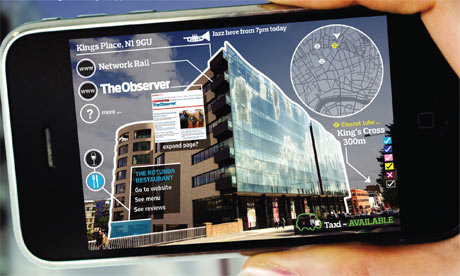
It seems that I was previously mistaken. There are a number of groups that are implementing preliminary hardware and software for mobile and otherwise that is beginning to collapse the divide between our cyber and material worlds.

It's hard to comment on all of this stuff as I am a tad overwhelmed. Nevertheless, here are some preliminary thoughts.
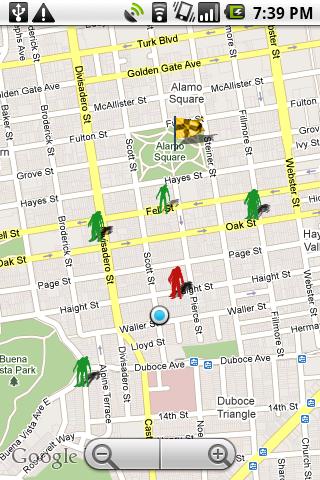
For the games, I would like to see some gaming classics like PacMan get reinterpreted. It would also be nice to see someone explore the current limitations of our hardware so that we have an idea of where the boundary is in this domain. I think the explosion of excitement in this industry, though wonderful, had best be reined in. The domain is potentially infinite, but currently has some solid limitations in our hardware and software design. Rather than see programs and apps that really push the limits, I would like to see some slightly more modest but functional attempts. Take one facet of the infinite potential and develop it until it has some obvious practical usefulness. And, though I love these ideas (1 2), wearing a giant suit or helmet is... not feasible.

In this vein, I think I am following other thinkers. The importance of finding ways in which augmented reality, given its current limitations, can legitimately reinforce or support our current existence in our environments is pertinent. That is, given a camera, gps, a small screen or primitive glasses (1 2), an accelerometer and/or gyroscope, a live feed to the internet and the cloud, audio input/output, and a touch screen, what can be implemented?

The cloud offers the ability to extend our memory capacity if we can find a seamless way to 'recall' the information or begin to implement triggers (e.g., visual, auditory, etc.). If someone could find a way to integrate this with multilingualism (i.e., by having a list of common phrases, etc.), I think traveling would become much simpler.

The accelerometer and gyroscope offer an alternative to touch screens. Just hold your phone and swipe it around like a computer mouse. In fact, I'm surprised I have not seen any software implementing smartphones as UI for standard computers. Though, I have heard of other countries using it for UI more generically. And, actually, the idea of being able to graphically scan anything and have my smartphone find where I can buy it, virtually or otherwise, is certainly worth exploring.


This software has some interesting uses socially. I can see a time when people have clothing that encodes their 'avatar' (i.e., appearance) in cyberspace so that they are seen as such through AR. Subcultures, I'm sure, will be able to integrate this as an interesting form of identification. There are possible consequences here for gangs, etc.  as well as the police. On the extreme end, machines could be seen in a more anthropomorphic frame, which might have interesting repercussions for our relationships with them and we may be able to project our avatars to new places in order to send cues, or even interact with the world. Imagine your phone's 'ring tone' was the person appearing in your peripheral vision and waving at you. Interesting implications for the research I have heard on less invasive forms of human-computer interaction.

Actually, this would be an interesting way to implement some of the ideas I discussed previously. I could have it such that messages or social cues, interests, etc. are encoded right on my person (e.g., approachable, busy, single, etc.). If people start doing this with tattoos, that would certainly be fascinating. And, to forecast a future post, the ability to tag others given a particular network or context would be fascinating, too, especially with ratings.

Images courtesy of:
http://www.guardian.co.uk/technology/2010/mar/21/augmented-reality-iphone-advertising
https://t.co/5jjnouAY
http://strangehorizons.blogspot.ca/2011_06_01_archive.html

Wednesday, June 20, 2012

Y!kes: Implications for augmented reality

The current take on mobile applications demonstrated through the upcoming software Y!kes is an inspiration for us all. Too long have we lived in Descartes' rendition of cyberspace--a fact that is all the stranger given the ever increasingly pervasive smartphone. How is it that so few people are capitalizing on the capacity for this conveniently sized, networked, computer to augment our day-to-day reality? The answer eludes me. Nevertheless, I think the move Y!kes is taking is a big one, and not just for Hotels.
What Y!kes seeks to do is transform your mobile phone into a networked passport for your evenings away from home. Elevators pick your floor; doors unlock and lock themselves; your bed and breakfast is prepped on arrival at the airport. Surely, this is just the beginning.

I personally see this idea expanding into life in general and, especially, social networking. When you walk into your local store, relevant advertising and specials will pop-up on your phone (e.g., Google, Facebook, Cloudmade). Hotels will start registering you upon entering their establishment. Restaurants will start seating you, give you the menu, and begin ordering your food. Your mobile will create a seamless flow of relation without all the standard wait times and administrative hiccups. And this is just via position. Start scanning audio and this ever expands the framework of anticipation. Add visual scan and augmentation and you are really rolling. Perhaps this may all seem far away, but at the current rate of technological advancement how long, really, is 'far away?'

In the social sphere, I can see networking sites starting to really utilize the presence of the smartphone as Y!kes has. People will be able to scan for live profiles in their immediate vicinity, which will or won't be visible depending on the networks you are associated with. Social interaction will be augmented as individuals will already know each others likes and dislikes, favourite topics of conversation, and more. They will be able to ping one another to invite conversation or be in an 'open' status where meetings are always welcome. They will be notified when friends are close by, assuming they are 'live.' Social reality will be augmented.

So what are you waiting for Developers? Let the technological race begin!

Tuesday, June 19, 2012

An emphasis on hardware

I would like to take this article as a jumping point.

It's interesting to run into an article of similar mind, if from a different position. The gist of the article being predictive: the recent advancements in software development in the current digital context is perhaps shifting advantageously towards hardware development. That is, micro development is now possible materially as well as virtually. My thoughts are an effort to move this development forward through a re-conceptualization of the environment, much as Brondmo did in the article, above.

It is my sense that the greater majority has largely forgotten about hardware. Software has become predominantly cross-platform while decent hardware comes in increasingly cheap package deals at your local tech shop (i.e., you don't even need to know what you're buying to run it). Yet, in place of this standard conception of hardware as 'the thing on which the software operates,' I would like to propose an alternative: materiality is just as equally infinite potential.

A few thought experiments.

First, take any old intersection with a traffic light during rush hour. Assuming two individuals knew of this intersection, a time to watch it, and had a means to control the traffic light, one could transform this innocuous location into a transmitter of information. That is, the cars themselves could become data packets, either ones and zeros or Morse code's dashes and dots.

Second, take any communication line (Ethernet, Coaxial, Fiber-Optic, etc.). In the standard conception, information goes into the line and comes out of the line with a bit of noise in the middle. This middle part seems particularly interesting to me. Is it possible to create information through the use of interference patterns in the actual signal? Perhaps the role could be that of a firewall. If the signal is sent incorrectly, the interference distorts it incoherently and, thus, it becomes noise. With the right signal, both the information being sent as well as the reception become coherent. Thus, in actuality, you are getting two things in one: encryption and decryption/firewall except at the hardware level.

Third, take, once again, a firewall, but a standard software-level firewall, in this case. This firewall, when it detects a malicious threat, assesses the degree of the threat, traces it, and disables its router at the hardware level. If this is too volatile a tech to give to consumers, then perhaps the firewall sends information to a centralized agency/computer that flags the threat, continues assessment and proceeds with physical dismissal of the router or a complete decommissioning of the computer.

The latter idea is likely dangerous, but it illustrates my point quite well: hardware is a virtually untapped domain given the new tools we have developed in the previous software era.